How to Build a Gallery Wall That Actually Means Something
Let's be honest: a lot of gallery walls look great in photos and feel kind of hollow in person. You've seen them — perfectly spaced black frames, a mix of botanical prints downloaded from Etsy, maybe a motivational word or two. They're fine. They're just not yours.
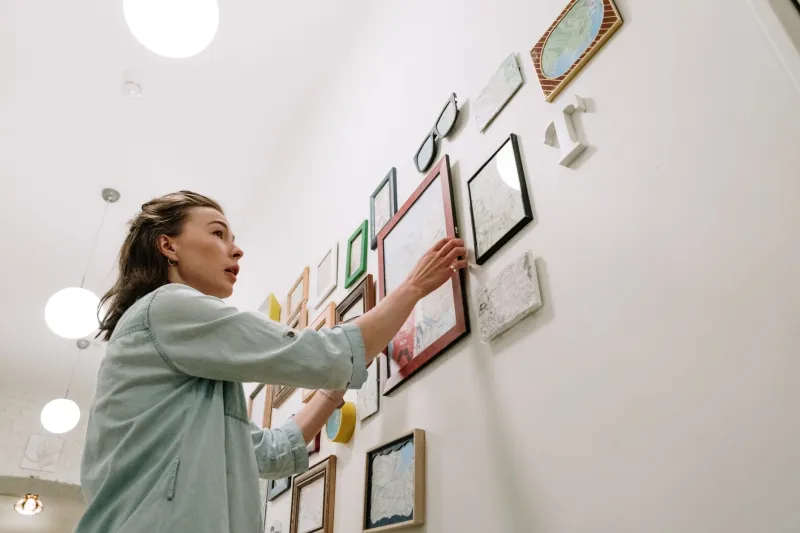
The gallery wall at its best is something entirely different. It's a visual autobiography — a collection of moments, places, people, and ideas that tells the story of your actual life. Getting there takes a little planning and a willingness to mix things that don't "match" in the traditional sense. But the result is a wall that stops people mid-conversation and makes them want to look closer.
Here's how to get there.
Start With the Story, Not the Frames
Before you buy a single frame or measure a single inch of wall, sit with a question: What do I want this wall to say?
Maybe it's a chronicle of your travels — ticket stubs, a hand-drawn map of a road trip, photos from national parks you've hiked. Maybe it's a love letter to your family, spanning generations of black-and-white portraits alongside candid iPhone snapshots. Maybe it's an expression of your creative obsessions — album covers, architectural sketches, postcards from art museums.
The story doesn't have to be one thing. The best gallery walls often layer a few different threads — personal history, aesthetic passion, and humor all woven together. But having some sense of the narrative before you start collecting pieces will save you from ending up with a random assortment of stuff that happens to share a wall.
Write it down if that helps. Even a few bullet points — "road trips, family, music, things that made me laugh" — gives you a filter for what belongs and what doesn't.
What Goes on a Gallery Wall (Beyond the Obvious)
Photographs are the obvious starting point, and they absolutely belong. But the most compelling gallery walls include things that aren't framed prints at all.
Think about what you've collected over the years without realizing it. Postcards from friends who travel. A letter from someone who meant a lot to you. A small painting you picked up at a local art fair in Austin or Portland. A page torn from a vintage field guide. A child's drawing that's too good to stay on the fridge forever. A pressed flower from your wedding or your grandmother's garden.
These items don't need to be precious or expensive. They need to be meaningful. A $3 frame from a thrift store holding a polaroid from a camping trip will always be more interesting than a $60 print that could be on anyone's wall.
Other elements worth considering:
- Mirrors — they add depth and light, and a small decorative mirror can break up the visual rhythm in a really satisfying way
- Small shelves — a floating ledge lets you add three-dimensional objects like a tiny plant, a ceramic figure, or a stack of books
- Fabric or textile pieces — a small woven piece or embroidered hoop adds texture that flat frames can't
- Typography — a single meaningful word or phrase, hand-lettered or printed, can anchor the whole composition
The Layout: Getting the Arrangement Right
This is where most people get stuck. The good news is that there's no single right way to arrange a gallery wall — but there are a few approaches that consistently work well.
The Grid is the most structured option: equal spacing, same-size frames, clean rows and columns. It works beautifully in modern or minimalist spaces and is especially satisfying if you're a person who values order. The downside is that it can feel rigid if your content is really varied in tone.
The Organic Cluster is the opposite — a loose, asymmetrical grouping that expands outward from a central anchor piece. This is the most forgiving layout for mixing different frame sizes and shapes, and it tends to feel the most personal and lived-in. Start with your largest or most meaningful piece in the center-ish area and build outward.
The Salon Style goes floor to ceiling and wall to wall with overlapping frames at varying heights. It's maximalist, dramatic, and incredibly warm when done right. Think of it as the gallery wall equivalent of a full bookshelf — it takes up space intentionally and makes no apologies.
The Ledge Display skips hanging altogether. You mount one or two picture ledges and lean frames against the wall, letting you rearrange and swap pieces constantly. It's perfect for people who love the idea of a gallery wall but aren't ready to commit to holes in the plaster — and it's especially great for renters.
The Practical Stuff: Making It Happen Without Losing Your Mind
Once you've got your pieces and a general layout in mind, here's a process that makes the actual hanging much less stressful:
-
Lay everything out on the floor first. Arrange your pieces on the ground in front of the wall you're working with. Adjust until you're happy with the composition. Take a photo.
-
Trace your frames on kraft paper. Cut out paper templates for each piece, tape them to the wall with painter's tape, and step back. This lets you see the full layout before you commit to a single nail.
-
Mark your nail holes through the paper. Once you're satisfied, mark the hanging point on each paper template and nail right through it. Tear the paper away and hang your pieces.
-
Use a level — but don't obsess. A slightly tilted frame in an organic gallery wall is barely noticeable. A slightly tilted frame in a precise grid is immediately obvious. Know which kind of wall you're building.
-
Leave room to grow. The best gallery walls aren't finished all at once. Build in a few blank spots you'll fill in over time as you collect new pieces. A wall that evolves with you is always more interesting than one that's frozen in a single moment.
The Secret Ingredient
The gallery walls that people remember — the ones they photograph and ask about and feel genuinely moved by — share one quality: specificity. They don't try to look like something from a catalog. They look like the person who made them.
Your wall doesn't need to be perfectly curated or stylistically cohesive. It needs to be honest. It needs to hold the things that actually matter to you, arranged in a way that invites people to look closely and learn something real.
That's the whole point. Your walls are telling your story whether you're intentional about it or not. A gallery wall just gives you the chance to make sure they're telling the right one.